![Scope Scoop [Enerlytics AI]](/_next/image?url=https%3A%2F%2Fcsuxjmfbwmkxiegfpljm.supabase.co%2Fstorage%2Fv1%2Fobject%2Fpublic%2Fuser-uploads%2Forg-website-56858%2Flogo-1789419472761.jpg&w=384&q=75)
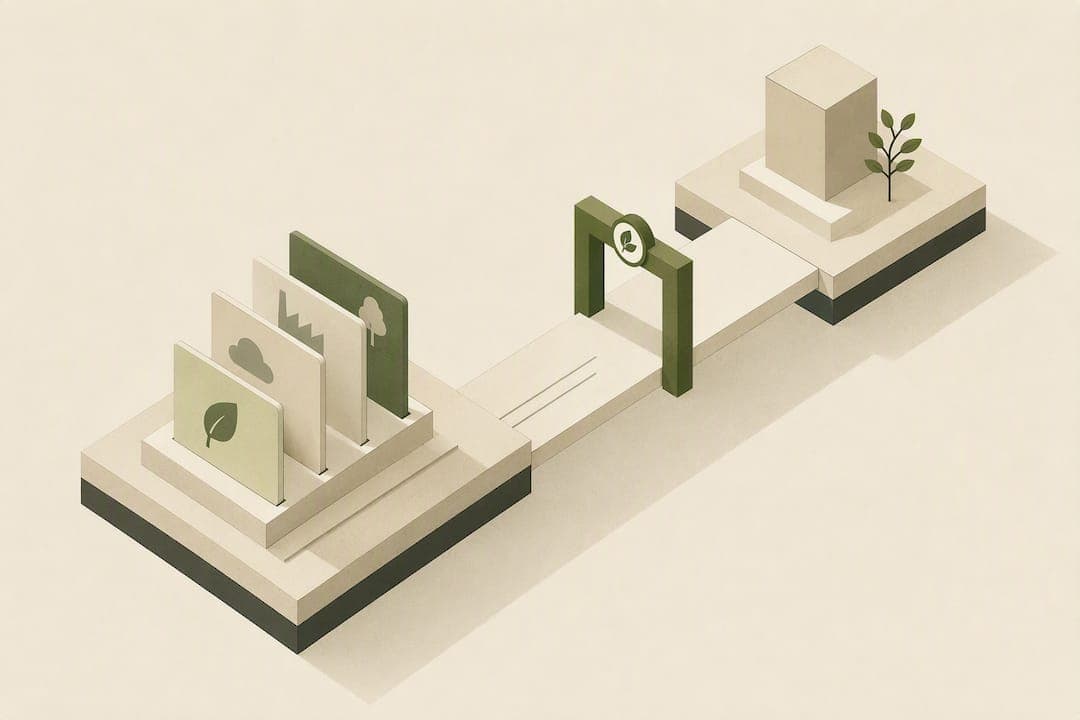
Yes, PPN 06/21 requires suppliers bidding for major UK government contracts to publish a Carbon Reduction Plan, and the policy is now called PPN 006. If your anticipated contract value hits £5 million per annum or above, including VAT, you must publish a director-signed CRP on your UK website using the official template before you reach the selection stage. Miss it, and you risk disqualification.
TL;DR:
- Suppliers bidding for contracts worth £5 million or more annually must publish a director-signed Carbon Reduction Plan on their UK website before selection, or risk disqualification.
- The plan must demonstrate commitment to Net Zero by 2050, include full Scope 1 and 2 emissions, and cover all five specified Scope 3 categories, with signed and recent documentation.
- The official template should be used exactly as provided, reporting data against a consistent baseline year, and referencing current UK GHG conversion factors.
- Common reasons for plan rejection include missing Scope 3 categories, outdated signatures, and inaccessible publication links, making thorough internal checks essential.
- Tools like Enerlyticsai streamline data collection, application of UK standards, and template population, helping suppliers produce compliant CRPs efficiently.
Table of Contents
- What does PPN 006 require? A compliance checklist
- How do you complete the official Carbon Reduction Plan template?
- Scope 1, Scope 2 and the five Scope 3 categories explained
- How is the carbon reduction plan assessed during procurement?
- What mistakes get carbon reduction plans rejected?
- How Enerlyticsai supports a compliant carbon reduction plan
- A procurement lead's priority checklist
- Start preparing your compliant carbon reduction plan today
- Sources
- FAQ
What does PPN 006 require? A compliance checklist
The renaming from PPN 06/21 to PPN 006 took effect in February 2025, aligned with the Procurement Act 2023 and the Procurement Regulations 2024. The substance did not change. Suppliers bidding for contracts valued at £5 million per annum or above still need a compliant CRP, and existing plans built under PPN 06/21 remain valid provided the annual data review has been kept current.
Before anything else, confirm your tender is genuinely in scope. Check the contract value against the £5 million threshold, whether a CRP requirement is proportionate to the subject matter, and how the rules apply if you're bidding into a framework or Dynamic Purchasing System rather than a standalone contract.
Once you know you're in scope, your CRP needs to demonstrate:
- A signed declaration of commitment to achieve Net Zero by 2050
- Current and baseline year emissions covering Scope 1 and Scope 2 in full
- The five specified Scope 3 categories, not a partial selection
- Concrete reduction actions with dates and expected impact
- Director sign-off dated within a recent 12-month period
- Publication on your UK website, or written delivery within 30 days if you have none
Buyers apply this as a pass/fail compliance check, not a scored criterion. A missing Scope 3 category or an undated signature is enough to fail the check, regardless of how strong the rest of the plan looks.
How do you complete the official Carbon Reduction Plan template?
The official template exists precisely so buyers can compare like with like. Deviating from its structure is only acceptable if every required field still appears in the same order, so most suppliers are better off using it exactly as published.
- Pick a baseline year and hold it. Use a full 12-month period with reliable data, then report every subsequent year against that same baseline so trends are comparable.
- Pull Scope 1 and 2 figures from primary records. Fleet fuel receipts, boiler gas bills, and electricity invoices give you the raw activity data; apply the latest UK Government GHG conversion factors to convert them into tonnes of CO2e.
- Work through the five Scope 3 categories methodically. Business travel and commuting often come from expense claims or a staff travel survey; waste figures come from your contractor's collection invoices; upstream and downstream transport data comes from freight manifests or, where records are thin, distance-and-weight estimates using standard conversion factors.
- Write reduction actions as commitments, not aspirations. Each one needs a timeline and a stated expected impact, for example, a fleet electrification programme with a completion year and a tonnage reduction estimate.
- Get director sign-off. Include the director's name, job title, and a signature date within the last 12 months.
- Publish it prominently. Put it on your UK website where a buyer can find it without asking, and keep the link current across procurement cycles.
Pro Tip: Keep a working spreadsheet of your invoice sources and conversion factor version numbers alongside the published CRP. When a buyer's evaluator queries a figure during due diligence, you want to answer in minutes, not days.
Scope 1, Scope 2 and the five Scope 3 categories explained
Scope 1 covers emissions your organisation generates directly, gas burned in your own boilers, fuel burned in your owned or leased vehicle fleet. Scope 2 covers the emissions embedded in electricity and heat you purchase but don't generate yourself.
The five Scope 3 categories PPN 006 specifies are narrower than the full Scope 3 standard, which is a relief for most suppliers:
- Business travel — mileage claims, rail and air bookings
- Employee commuting — a periodic staff travel survey is the standard proxy
- Waste generated in operations — your waste contractor's tonnage invoices
- Upstream transportation and distribution — supplier freight and delivery records
- Downstream transportation and distribution — outbound logistics manifests
Apply the current UK GHG conversion factors set consistently across every category, and note the version and publication year you used, since factors are updated annually. Larger suppliers sometimes seek third-party assurance against standards like ISO 14064-3 or ISAE 3410, though this isn't a stated PPN 006 requirement for most bids.
How is the carbon reduction plan assessed during procurement?
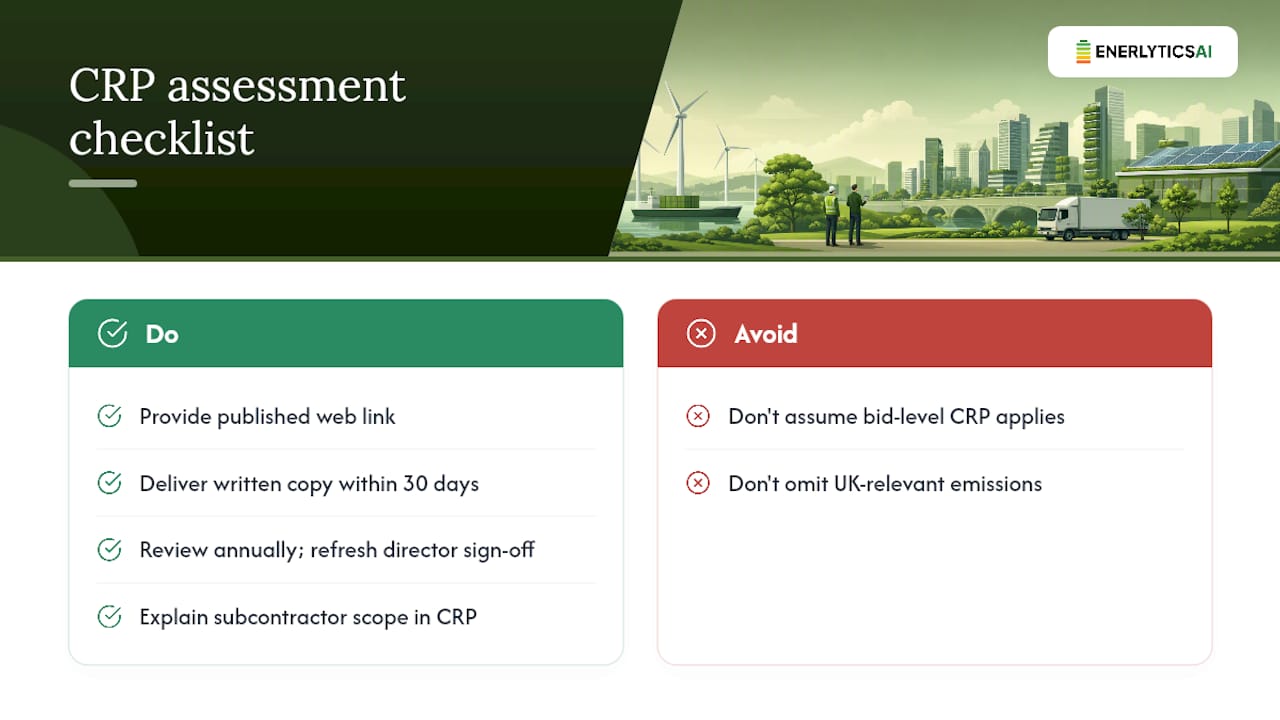
Buyers check your CRP at the selection stage, effectively the conditions of participation, rather than scoring it alongside your technical or commercial bid. You'll typically be asked to provide the published web link, or a written copy delivered within 30 days if you have no website of your own.
For frameworks and Dynamic Purchasing Systems, the CRP requirement applies at the framework or DPS level where the value and subject matter make that proportionate, so check the specific procurement documents rather than assuming a blanket rule. Overseas suppliers with UK operations are expected to report UK-relevant emissions where the contract touches UK delivery. Subcontractors aren't usually required to submit their own CRP, but prime contractors should expect buyers to ask how subcontracted work fits into the wider reduction plan.
Your CRP needs reviewing and updating at least annually, with director sign-off refreshed within a rolling 12-month window, not just at the point of each new bid.
What mistakes get carbon reduction plans rejected?
Most rejected CRPs fail for avoidable reasons rather than genuinely poor carbon performance. The most common errors:
- Submitting a CSR or ESG report instead of the CRP template. These documents often look comprehensive but rarely map cleanly onto the required fields, which is exactly what evaluators check first.
- Omitting one or more of the five required Scope 3 categories. Partial reporting, even with strong Scope 1 and 2 data, fails the check.
- Missing or stale director sign-off. A signature older than 12 months is treated the same as no signature at all.
- No working publication link, or a link buried several clicks deep. Buyers expect to find it quickly on your website.
- Numbers that don't reference the correct conversion factor set. Using outdated or unstated factors invites a query you don't need mid-tender.
Before submission, run through a short final check: correct template title and format, all sections present in the original order, current dates throughout, a live publication link, a dated director signature, and figures calculated against the current conversion factors.
How Enerlyticsai supports a compliant carbon reduction plan
Producing a defensible CRP means pulling data from invoices, fuel records, and travel logs, then applying the right conversion factors consistently. That's the part Enerlyticsai is built to shorten.
The platform handles:
- AI-assisted collection of energy and fuel data from invoices and utility records
- Automated application of current UK GHG conversion factors across Scope 1, 2 and the specified Scope 3 categories
- Population of template fields with auditable, traceable source data
- Ongoing monitoring so your CRP stays current between annual director sign-offs, rather than becoming a one-off exercise
For suppliers rebidding across multiple procurement cycles, that continuity matters. A CRP built on live, structured data is easier to refresh each year than one reconstructed from scratch every time a new tender lands.
A procurement lead's priority checklist
If you're short on time, spend it here first: get your Scope 1 and 2 figures right using verifiable invoice data, then build pragmatic collection methods for the five Scope 3 categories rather than chasing perfect data you don't have. Use the official template and current DEFRA conversion factors rather than adapting your own format. Buyers want measurable evidence, not a polished narrative.
— Chris
Start preparing your compliant carbon reduction plan today
Enerlyticsai gives sustainability and procurement teams a faster route to a defensible CRP than building one manually from scattered invoices and spreadsheets, because the data collection, conversion factor application, and template population happen in one connected workflow rather than across separate tools.
A free trial lets you connect your energy invoices, apply current UK GHG conversion factors automatically, and populate the CRP template fields with traceable source data before committing to anything. Utilities, sustainability consultants, and corporate compliance teams can use the trial period to test whether the platform's output holds up against their own manual figures. Start with the Carbon & Enterprise Reporting platform and see how much of your next CRP you can complete before your existing deadline.
FAQ
What is PPN 006?
PPN 006 is the renamed version of PPN 06/21, the UK government policy requiring suppliers bidding for major contracts worth £5 million per annum or more, including VAT, to publish a Carbon Reduction Plan. The renaming took effect in February 2025 and reflects new procurement legislation, not a change in the underlying requirements.
What are the UK government's plans to reduce carbon emissions in public procurement?
Beyond PPN 006, government buyers use supplier CRPs as a pass/fail gate at the selection stage, meaning suppliers without Net Zero commitments and credible reduction actions can be excluded from major contracts before commercial evaluation even begins.
Will net zero be scrapped in the UK?
The Net Zero by 2050 target remains UK government policy, and PPN 006 continues to require suppliers to declare commitment to it as part of a compliant Carbon Reduction Plan. Any change to the underlying target would need to come through separate legislation, not procurement guidance.
Do I need third-party verification for my carbon reduction plan?
PPN 006 does not mandate third-party assurance for most bids, though some larger suppliers seek verification against standards like ISO 14064-3 to strengthen confidence in their figures ahead of high-value tenders.
Can Enerlyticsai help me prepare a Carbon Reduction Plan?
Enerlyticsai automates the data collection and conversion factor calculations behind Scope 1, 2, and the required Scope 3 categories, helping you populate the official CRP template with auditable figures. For current pricing details, please visit the Enerlyticsai site.